
MSDS Authoring and Writing Services

Hazard Information

Hazard Statements, or H-statements, are part of the Globally Harmonized System of Classification and Labeling of Chemicals (GHS). H-statements provide standardized wording and pictograms to indicate the chemical hazards of a product, including the degree of chemical hazard.


Hazard Statements are assigned a unique numerical code, which can be used as a useful reference when translating labels and MSDS data sheets. Keep in mind that the codes are not a substitute for writing out the entire text of the H-statement.


H-Statements take the form Hnxx, where H stands for “hazard statement” or “H-statement”; n is substituted with 2 for physical hazards, 3 for health hazards, and 4 for environmental factors. xx is a sequential numbering scheme.

Physical Hazard: Explosives
Hazard Category


Unstable Explosive


Division 1.1


Division 1.2


Division 1.3


Division 1.4


Division 1.5


Division 1.6

Signal Word


Danger


Danger


Danger

Hazard Statement


Unstable Explosive


Explosion;

Mass explosion

hazard


Explosion; Severe Projection Hazard


Explosion; fire, blast or projection hazard


Fire or Projection Hazard


May explode in fire

Hazard Symbol

Transport Symbol


Additional Information: An explosive substance is a solid or liquid material that, by chemical reactive, is in itself capable of producing gas at such a temperature and pressure and at such a speed as to cause damage to the surroundings. A pyrotechnic substance or mixture is designed to produce an effect by heat, light, sound, gas, or smoke as the result of non-detonative self-sustaining exothermic chemical reactions. Explosive articles contain one or more explosive substance or mixtures while a pyrotechnic articles contain one or more pyrotechnic substances or mixtures.


For additional MSDS GHS terms, view the GHS glossary.
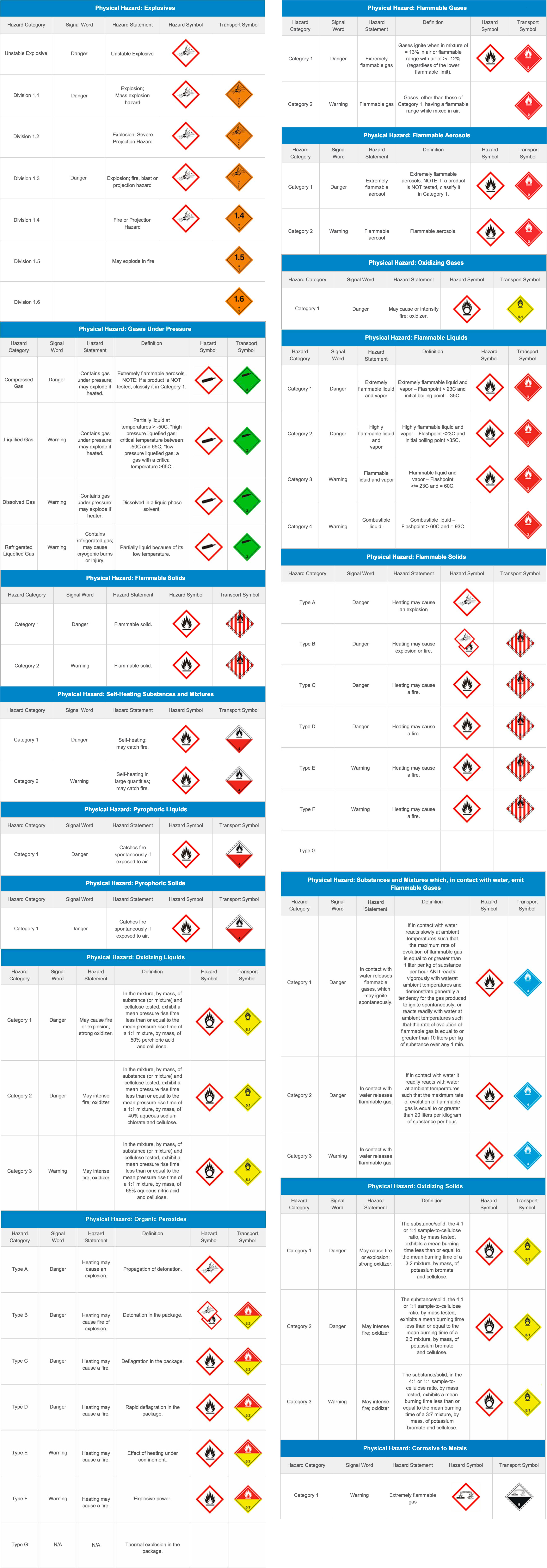
Physical Hazard: Flammable Gases

Hazard

Category


Category 1


Category 2

Signal

Word


Danger


Warning

Hazard Statement


Extremely flammable gas


Flammable gas

Definition


Gases ignite when in mixture of
= 13% in air or flammable
range with air of >/=12% (regardless of the lower flammable limit).


Gases, other than those of Category 1, having a flammable range while mixed in air.

Hazard

Symbol

Transport Symbol

Physical Hazard: Flammable Aerosols

Hazard

Category


Category 1


Category 2

Signal

Word


Danger


Warning

Hazard Statement


Extremely flammable aerosol


Flammable aerosol

Definition


Extremely flammable

aerosols. NOTE: If a product

is NOT tested, classify it

in Category 1.


Flammable aerosols.

Hazard

Symbol

Transport Symbol

Physical Hazard: Oxidizing Gases
Hazard Category


Category 1

Signal Word


Danger

Hazard Statement


May cause or intensify fire; oxidizer.

Hazard Symbol

Transport Symbol

Physical Hazard: Gases Under Pressure

Hazard

Category


Compressed Gas


Liquified Gas


Dissolved Gas


Refrigerated Liquefied Gas

Signal

Word


Danger


Warning


Warning


Warning

Hazard Statement


Contains gas under pressure; may explode if heated.


Contains gas under pressure; may explode if heated.


Contains gas under pressure; may explode if heater.


Contains refrigerated gas; may cause cryogenic burns or injury.

Definition


Extremely flammable aerosols. NOTE: If a product is NOT
tested, classify it in Category 1.


Partially liquid at

temperatures > -50C. *high pressure liquefied gas:

critical temperature between
-50C and 65C; *low

pressure liquefied gas: a

gas with a critical

temperature >65C.


Dissolved in a liquid phase solvent.


Partially liquid because of its
low temperature.

Hazard

Symbol

Transport Symbol

Physical Hazard: Flammable Liquids

Hazard

Category


Category 1


Category 2


Category 3


Category 4

Signal

Word


Danger


Danger


Warning


Warning

Hazard Statement


Extremely flammable liquid and vapor


Highly flammable liquid and
vapor


Flammable liquid and vapor


Combustible liquid.

Definition


Extremely flammable liquid and vapor – Flashpoint < 23C and initial boiling point = 35C.


Highly flammable liquid and
vapor – Flashpoint <23C and
initial boiling point >35C.


Flammable liquid and

vapor – Flashpoint

>/= 23C and = 60C.


Combustible liquid –

Flashpoint > 60C and = 93C

Hazard

Symbol

Transport Symbol

Physical Hazard: Flammable Solids
Hazard Category


Category 1


Category 2

Signal Word


Danger


Warning

Hazard Statement


Flammable solid.


Flammable solid.

Hazard Symbol

Transport Symbol

Hazard Category


Type A


Type B


Type C


Type D


Type E


Type F


Type G

Signal Word


Danger


Danger


Danger


Danger


Warning


Warning


Hazard Statement


Heating may cause

an explosion


Heating may cause explosion or fire.


Heating may cause

a fire.


Heating may cause

a fire.


Heating may cause

a fire.


Heating may cause

a fire.

Hazard Symbol

Transport Symbol

Physical Hazard: Self-Heating Substances and Mixtures
Hazard Category


Category 1


Category 2

Signal Word


Danger


Warning

Hazard Statement


Self-heating;

may catch fire.


Self-heating in

large quantities;

may catch fire.

Hazard Symbol

Transport Symbol

Physical Hazard: Pyrophoric Liquids
Hazard Category


Category 1

Signal Word


Danger

Hazard Statement


Catches fire spontaneously if exposed to air.

Hazard Symbol

Transport Symbol

Physical Hazard: Pyrophoric Solids
Hazard Category


Category 1

Signal Word


Danger

Hazard Statement


Catches fire spontaneously if exposed to air.

Hazard Symbol

Transport Symbol

Physical Hazard: Substances and Mixtures which, in contact with water, emit
Flammable Gases

Hazard

Category


Category 1


Category 2


Category 3

Signal

Word


Danger


Danger


Warning

Hazard Statement


In contact with water releases flammable gases, which may ignite spontaneously.


In contact with water releases flammable gas.


In contact with water releases flammable gas.

Definition


If in contact with water

reacts slowly at ambient temperatures such that

the maximum rate of

evolution of flammable gas

is equal to or greater than

1 liter per kg of substance

per hour AND reacts

vigorously with waterat

ambient temperatures and demonstrate generally a
tendency for the gas produced
to ignite spontaneously, or
reacts readily with water at

ambient temperatures such

that the rate of evolution of flammable gas is equal to or greater than 10 liters per kg

of substance over any 1 min.


If in contact with water it

readily reacts with water

at ambient temperatures

such that the maximum rate

of evolution of flammable

gas is equal to or greater

than 20 liters per kilogram

of substance per hour.

Hazard

Symbol

Transport Symbol

Physical Hazard: Oxidizing Liquids

Hazard

Category


Category 1


Category 2


Category 3

Signal

Word


Danger


Danger


Warning

Hazard Statement


May cause fire or explosion; strong oxidizer.


May intense

fire; oxidizer


May intense

fire; oxidizer

Definition


In the mixture, by mass, of substance (or mixture) and cellulose tested, exhibit a

mean pressure rise time

less than or equal to the

mean pressure rise time of

a 1:1 mixture, by mass, of

50% perchloric acid

and cellulose.


In the mixture, by mass, of substance (or mixture) and cellulose tested, exhibit a

mean pressure rise time

less than or equal to the

mean pressure rise time of

a 1:1 mixture, by mass, of

40% aqueous sodium

chlorate and cellulose.


In the mixture, by mass, of substance (or mixture) and cellulose tested, exhibit a

mean pressure rise time

less than or equal to the

mean pressure rise time of

a 1:1 mixture, by mass, of

65% aqueous nitric acid

and cellulose.

Hazard

Symbol

Transport Symbol

Physical Hazard: Oxidizing Solids

Hazard

Category


Category 1


Category 2


Category 3

Signal

Word


Danger


Danger


Warning

Hazard Statement


May cause fire or explosion; strong oxidizer.


May intense

fire; oxidizer


May intense

fire; oxidizer

Definition


The substance/solid, the 4:1

or 1:1 sample-to-cellulose

ratio, by mass tested,

exhibits a mean burning

time less than or equal to

the mean burning time of a

3:2 mixture, by mass, of potassium bromate

and cellulose.


The substance/solid, the 4:1

or 1:1 sample-to-cellulose

ratio, by mass tested,

exhibits a mean burning time
less than or equal to the

mean burning time of a

2:3 mixture, by mass, of potassium bromate

and cellulose.


The substance/solid, in the

4:1 or 1:1 sample-to-

cellulose ratio, by mass

tested, exhibits a mean

burning time less than or

equal to the mean burning

time of a 3:7 mixture, by

mass, of potassium

bromate and cellulose.

Hazard

Symbol

Transport Symbol

Physical Hazard: Organic Peroxides

Hazard

Category


Type A


Type B


Type C


Type D


Type E


Type F


Type G

Signal

Word


Danger


Danger


Danger


Danger


Warning


Warning


N/A

Hazard Statement


Heating may cause an explosion.


Heating may cause fire of explosion.


Heating may cause a fire.


Heating may cause a fire.


Heating may cause a fire.


Heating may cause a fire.


N/A

Definition


Propagation of detonation.


Detonation in the package.


Deflagration in the package.


Rapid deflagration in the
package.


Effect of heating under confinement.


Explosive power.


Thermal explosion in the
package.

Hazard

Symbol

Transport Symbol

Physical Hazard: Corrosive to Metals

Hazard Category


Category 1

Signal Word


Warning

Hazard Statement


Extremely flammable gas

Hazard Symbol

Transport Symbol


Welcome to the GHS Hazard Information section of our web site. On this page you will find information about our GHS hazard information services. At this web site about Material Safety Data Sheets (MSDS) and Globally Harmonized System (GHS), you will be able to view our extensive MSDS content, request a quote for and get affordable prices on MSDS writing services. Unlike template driven MSDS writers and companies, the staff MSDS Authoring has over 14 years of experience and expertise writing accurate MSDS requirements. From MSDS consultation to getting more timely information about GHS, the team at MSD Authoring can assist you on every step of the process including MSDS consulting, analysis, chemical identification, storing, archiving to final delivery of high quality but low cost Material Safety Data Sheets (MSDS) and Globally Harmonized System (GHS). We invite you to receive an MSDS quote today by visiting our Request a Quote page. When it comes MSDS writing services or original MSDS or GHS authoring, you'll find no better writers than the experienced staff at MSDS Authoring Services. Thank you for visiting MSDSAuthoring.com and our company online and invite you to contact a MSDS writer at MSDS Authoring Services to start your quote process.
Quote Request